Vintage Hand-Painted Delft Polychrome Vase – De Delftse Pauw Holland
Vintage Hand-Painted Delft Polychrome Vase – De Delftse Pauw Holland
Couldn't load pickup availability
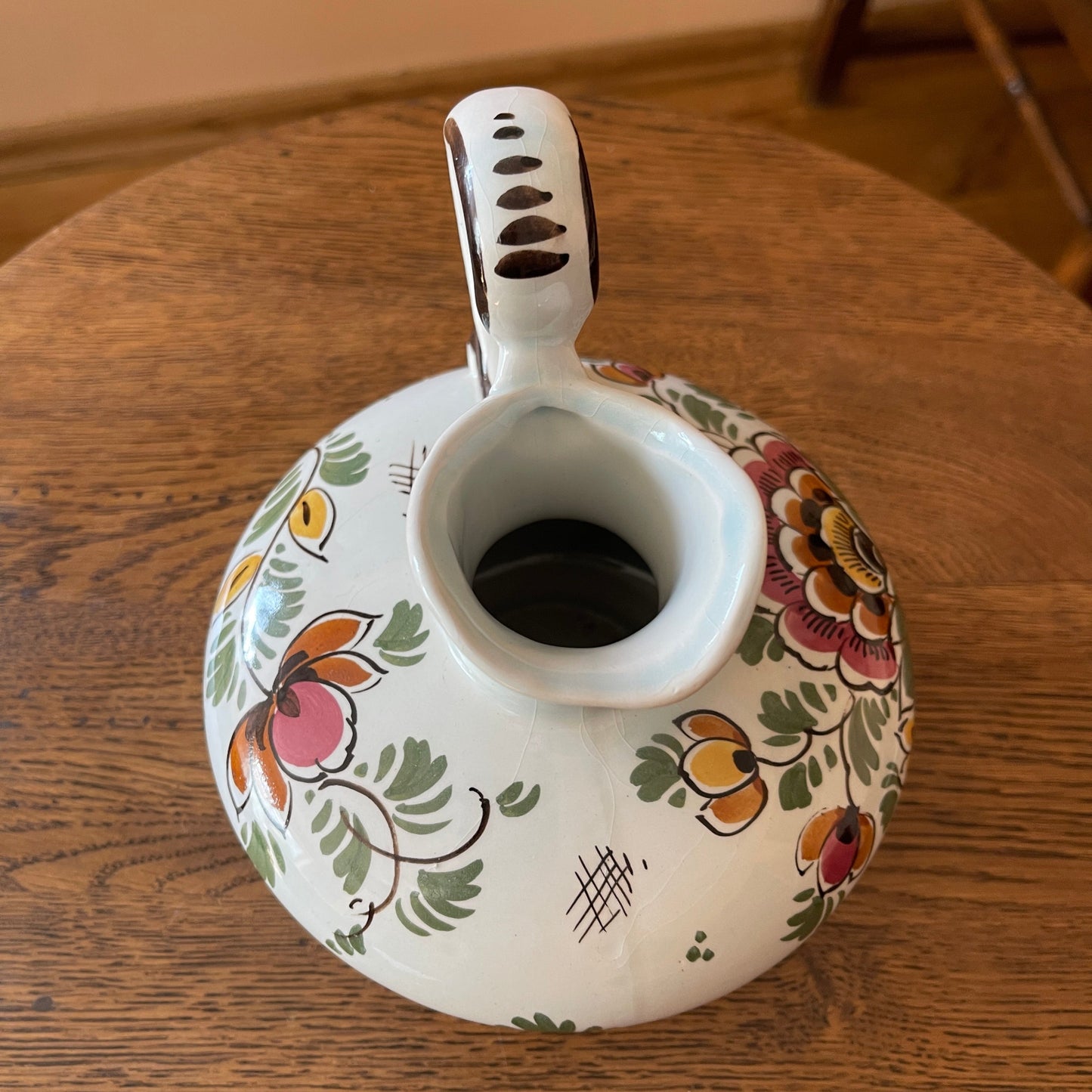
This striking vintage ceramic vase stands out with its unique, squat silhouette, featuring a wide body and a prominent, oversized handle. Crafted by the renowned Dutch factory De Delftse Pauw in Delft, this piece dates back to the second half of the 20th century, likely the 1970s. Unlike later productions, this earlier exemplar is undated, as the factory only introduced year coding in the 1990s.
The vase is beautifully hand-painted in a vibrant polychrome palette, decorated with traditional Dutch floral motifs. A visible crackle glaze (crazing) covers the surface, characteristic of authentic vintage Delftware, adding a layer of historical soul to the piece. It remains in excellent vintage condition with no damage, making it a sophisticated addition to any collection of European ceramics or a unique focal point for a classic interior.
Please review photos, as they are an integral part of the description.
Product details:
- Overall dimensions: Height 5 1/2"× Diameter 6″
- Technique: Hand-painted Delftware ceramic (Polychrome)
- Origin: Delft, Holland
- Date: Second half of the 20th century, Circa 1970s
- Signature: Fully signed on the bottom with factory marks and artist's initials.
- Condition: Excellent vintage condition; no chips or cracks; authentic visible crazing throughout.
De Delftse Pauw (The Delft Peacock) is one of the few remaining historic pottery factories in the Netherlands that continues the centuries-old tradition of entirely hand-painted Delftware. Its heritage dates back to the 17th century, though it has operated in its modern form as a specialized art studio since the mid-20th century.
The factory is highly regarded for its commitment to traditional craftsmanship; unlike many mass-producers, De Delftse Pauw does not use transfer-ware techniques (decals). Instead, every pattern is meticulously applied by brush by master ceramicists. The iconic peacock symbol in the hallmark serves as a guarantee of authenticity and superior artistic quality.
Notably, the factory only introduced a systematic year-coding system in the 1990s. Pieces featuring the full factory mark and artist's initials without a date code are typically attributed to the 1970s and 1980s, representing a prized era of contemporary Dutch faience focused on individual artistry and rich polychrome palettes.